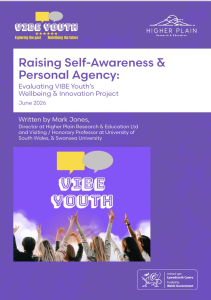
An independent evaluation of VIBE Youth’s Wellbeing & Innovation Project reveals a generation asking for something simple, and rarely given- to be truly listened to.
There’s a moment in the new independent evaluation of our Wellbeing & Innovation Project where a young person, reflecting on the labels that had followed them through school, says four words that have stayed with us since we first read them:
“I’m not a label.”
It’s a small sentence carrying a large idea. For many of the children and young people we worked with across Swansea, Neath Port Talbot, and Bridgend between September 2025 and March 2026, that sentence is the whole story. Not a story about poverty statistics or policy frameworks, although those matter too, but a story about what happens when a young person is finally given room to ask who am I, underneath everything I’ve been told I am?
Independently evaluated by Mark Jones of Higher Plain Research & Education, and funded through the Welsh Government’s Child Poverty – Innovation and Supporting Communities grant, the project worked with 52 children and young people aged 10 to 20, alongside teachers, our own facilitators, and adult community members navigating poverty firsthand. The findings are, in places, uplifting. In others, they’re uncomfortable and we feel both matter.
A Different Kind of Room
The project ran as a series of Wellbeing sessions that finished with VIBES Innovation labs, five-week journeys through self-awareness, values, emotional intelligence, and identity, followed by phases where young people designed their own responses to the poverty and exclusion they see around them. But the structure, while carefully built, wasn’t really the point. The point was the room itself, and what became possible inside it.
Across every age group, from primary children to young adults at college, one theme repeated with striking consistency, young people experienced VIBE as somewhere fundamentally different from school.
“It’s not like normal school which is loud and busy.”
“There’s not a wrong answer in this classroom.”
“This actually teaches you about yourself in real life.”
Teachers, who know these young people far better than any outside evaluator could, backed this up without hesitation. They described visible shifts in behaviour, empathy, and confidence. One was blunt about what that says about the system they work within every day: “Mainstream education doesn’t work for children with these high and complex needs.”
That’s not a criticism of teachers, if anything, it’s the opposite. It’s teachers themselves naming a gap they’re left to manage alone.
A Journey That Changes With Age
One of the most striking findings is how differently young people experienced the project depending on where they were in growing up.
The youngest children spoke in the language of safety and self-acceptance:
“I love myself now.” “I know I’m not bad.”
Early teenagers began connecting feelings to actions, learning to pause before reacting:
“I’ve learnt to stop just reacting.”
And by college age, something more abstract had taken root, a kind of critical thinking about identity itself:
“Words have power and it creates realities that might not actually be true.” “I get to decide my truth.”
It’s a quiet but profound progression. Younger children needed to feel safe, older ones needed to question the stories that had been written about them, often by people who never asked if those stories were true. Both are forms of the same need, to be seen as a person first, and a problem second.
The Part of the Story That’s Harder to Tell
It would be easy to end there, but the evaluation also captured the voices of adults in the community, parents and carers navigating poverty directly, and what they said deserves to sit at the centre of this article rather than its footnotes.
Every single adult who took part said that people with lived experience of poverty are rarely, or never, listened to when decisions are made about their lives. Not sometimes, not occasionally but every single one.
Seventy percent linked poverty primarily to structural causes rather than individual choices. Ninety percent said public systems, benefits, housing, education, simply aren’t working for them and some spoke with a kind of weary honesty that’s hard to read without feeling it:
“Why should we bother to be involved and share our lives? We’ve done this before and nothing ever gets done. We feel used.”
That’s a hard sentence for any organisation involved in “engagement” work to sit with. We’re choosing to sit with it anyway, because pretending it isn’t there helps no one.
What We’re Taking From This
We didn’t go into this project to prove a point, we went in because we believe deeply, that the most powerful insights into poverty and disconnection come from the people actually living through them, not from policy documents written at a distance.
What the evaluation confirms is something we’ve built our whole organisation around, that emotional safety, honest relationships, and the chance to be understood rather than managed, aren’t soft extras on top of “real” support. They are the foundation everything else is built on and without them, nothing else holds.
The report’s recommendations are practical: embed relational, youth work-led approaches into schools properly, not as short add-on interventions but as sustained, long-term provision; strengthen emotional literacy as a core part of education, not an afterthought; and build the kind of integrated, joined-up support across education, youth work, and community services that this report’s findings show is currently missing.
But underneath the recommendations is something simpler, a 16-year-old in this project put it better than we ever could:
“It’s no good being good at school stuff if you don’t understand yourself.”
VIBE challenges the status quo through innovative, evidence based approaches enabling individuals to rise up, take ownership of their futures, creating a sense of hope and purpose.Exploring the past- Redefining the future, it’s not just our strapline, it’s what young people, and the adults who love and support them, spent six months showing us is still desperately needed, and still entirely possible.
The full independent evaluation report, “Raising Self-Awareness & Personal Agency”, by Mark Jones of Higher Plain Research & Education, is available via the link. VIBE Youth CIC’s Wellbeing & Innovation Project was funded by the Welsh Government’s Child Poverty – Innovation and Supporting Communities grant 2025/26. Raising Self-Awareness & Personal Agency Report